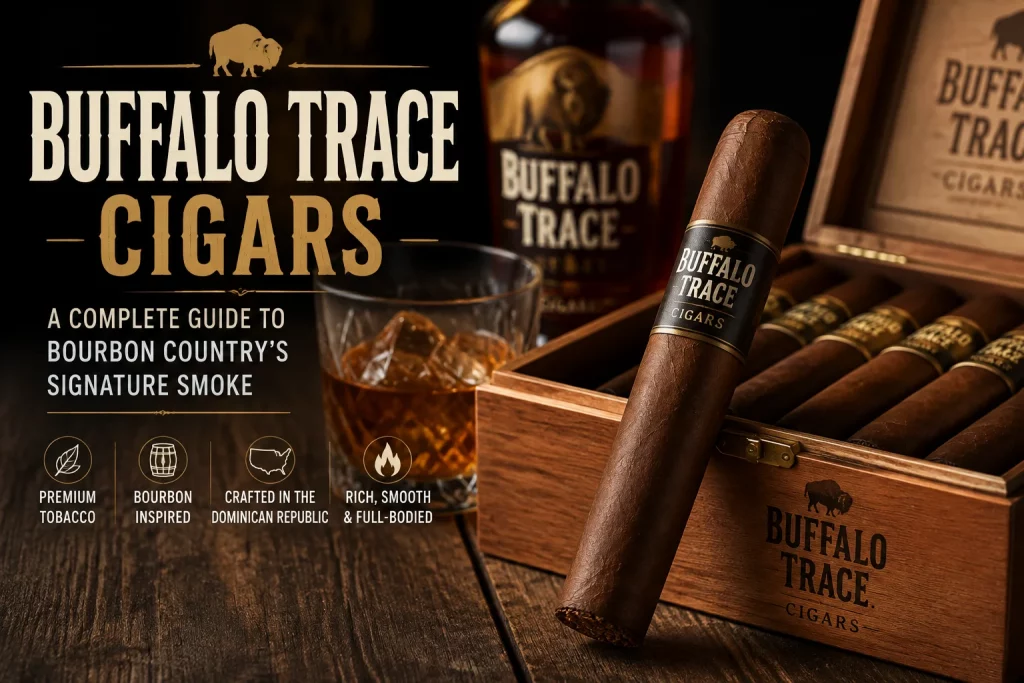
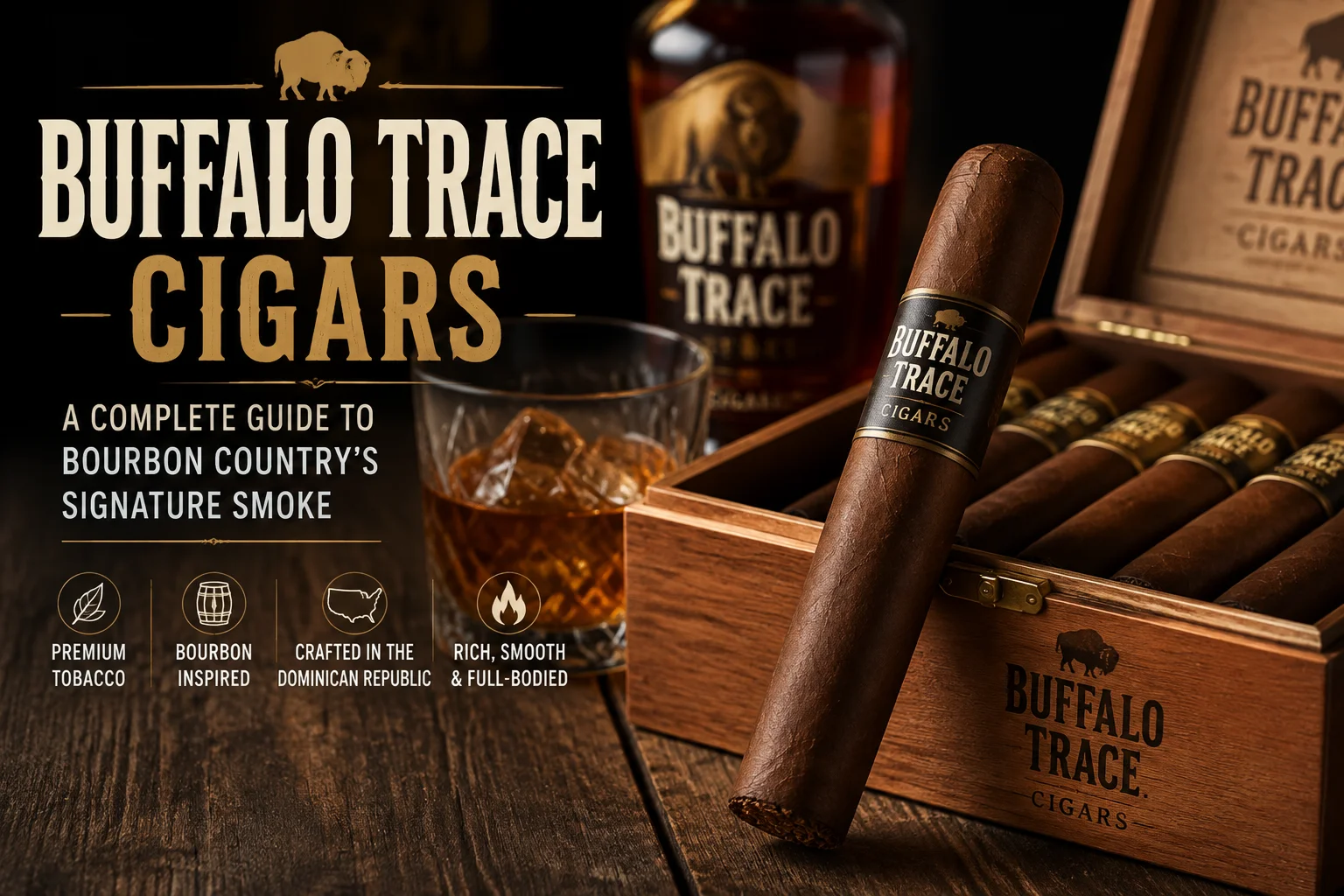
Few names in American spirits carry as much weight as Buffalo Trace. For more than two centuries, the distillery in Frankfort, Kentucky has produced some of the most celebrated bourbons in the country, and that reputation for craftsmanship eventually found its way into an entirely different category of product. Buffalo Trace cigars are the result of that crossover, a line built by Sazerac, the parent company behind the Buffalo Trace Distillery, aimed at giving bourbon lovers a smoking companion that reflects the same heritage they associate with the bottle. For anyone curious about what these cigars actually are, how they are made, what they taste like, and how they compare to other bourbon-inspired smokes on the market, this guide covers everything you need to know before you light one up.
The Origins of Buffalo Trace Cigars
Buffalo Trace Distillery has been in continuous operation since the late 1700s, surviving Prohibition, two world wars, and generations of ownership changes while never losing its reputation as one of the most respected names in bourbon. Sazerac, the company that now owns the distillery along with more than four hundred other spirits brands, has spent years expanding the Buffalo Trace name beyond the bottle. Branded merchandise, barbecue sauces, and eventually a premium cigar line all became part of that expansion strategy, tapping into a customer base that already associates the name with quality, tradition, and Kentucky craftsmanship.
Rather than manufacturing tobacco products themselves, Sazerac partnered with experienced cigar producers in the Dominican Republic to create a blend that would carry the Buffalo Trace name with the same care the distillery puts into aging its whiskey. The result launched as a full-bodied, handcrafted cigar meant to appeal both to lifelong cigar smokers and to bourbon drinkers who were being introduced to premium tobacco for the first time through the brand they already trusted.
What Goes Into a Buffalo Trace Cigar
The construction of a Buffalo Trace cigar reflects a deliberate attempt to balance strength with approachability. The wrapper is an Ecuadorian Sumatra leaf, prized in the cigar world for its smooth texture and its ability to bring out sweetness without overwhelming the smoker with bitterness. Underneath that wrapper sits a Brazilian Arapiraca binder, a leaf known for its dark color and its role in adding structure and a slow, even burn to the finished cigar. The filler tobacco is where the blend gets its real character, combining Dominican Piloto Cubano leaves with Nicaraguan tobacco for a filler that leans toward the fuller end of the flavor spectrum.
These cigars are handmade in Santiago, Dominican Republic, a region long associated with some of the finest cigar rolling houses in the world. The finished product is generally described as medium to full-bodied, landing in a strength range that experienced smokers will find satisfying without tipping into a profile so intense that newer smokers are scared off entirely. This balance is part of why Buffalo Trace cigars have found a fairly wide audience since their release, appealing to people who already enjoy full-flavored cigars while also drawing in bourbon enthusiasts who are exploring cigars for the first time. If you want to see how this blend compares against other specialty lines built around a strong brand identity, ourDeadwood cigars guide covers a similarly unconventional Drew Estate release worth reading alongside this one.
The Flavor Profile Explained
Anyone expecting a literal bourbon taste from a Buffalo Trace cigar should adjust their expectations slightly. These are not cigars where the tobacco has been physically aged inside used bourbon barrels, at least not in the way some competitors market their products. Instead, the flavor experience leans on the natural characteristics of the tobacco blend itself, which happens to complement bourbon extremely well thanks to its inherent woody and leathery notes.
Smokers commonly report an opening third that carries notes of cedar, black pepper, and a mild sweetness reminiscent of caramel. As the cigar progresses into its second third, the leather and earth notes typical of Nicaraguan filler tobacco begin to take over, giving the smoke more depth and a slightly heavier body. By the final third, many smokers describe a lingering, slightly spicy finish with just enough sweetness on the retrohale to remind you why this cigar was paired with a bourbon brand in the first place. It is a profile built for people who enjoy a cigar with genuine complexity rather than one that leans on artificial flavoring to create the illusion of sophistication. Smokers who enjoy this kind of natural, tobacco-forward sweetness may also want to compare it with the coffee-dusted profile found in our Tabak Especial cigar guide.
Available Sizes and Vitolas
Buffalo Trace cigars are typically offered in a handful of classic vitolas designed to suit different smoking occasions. The Robusto, one of the most popular sizes in the lineup, offers a shorter, more concentrated smoking experience that usually runs somewhere between forty-five minutes and an hour. For smokers who prefer a longer, more gradual burn, larger formats such as a Toro or Churchill style vitola are often available as well, stretching the smoking time closer to ninety minutes and allowing the flavor transitions across each third of the cigar to unfold more slowly. Smokers who prefer a shorter, more casual smoke may also want to look into our complete guide to mini cigars.
Because the brand is positioned as an accessible entry point into premium cigars for bourbon drinkers, the sizing tends to favor formats that are easy to recommend to newcomers while still giving experienced smokers enough ring gauge and length to appreciate the blend fully. Anyone shopping for their first box should consider starting with a Robusto to get a feel for the profile before committing to longer format boxes.
Why Bourbon Drinkers Gravitate Toward This Cigar
There is a psychological and sensory reason bourbon drinkers tend to enjoy cigars like this one so much. Bourbon itself carries notes of vanilla, oak, caramel, and spice, largely thanks to the charred oak barrels it ages in. Premium cigar tobacco, particularly filler leaves grown in Nicaragua and the Dominican Republic, often develops remarkably similar characteristics through its own curing and fermentation process. Wood, leather, spice, and a touch of natural sweetness show up in both products almost independently of one another, which is exactly why cigar and bourbon pairings have become such a popular pastime among enthusiasts of both.
Buffalo Trace leaned into that overlap intentionally when developing this cigar line, choosing a blend whose natural flavor profile would already feel familiar and comfortable to someone who spends their evenings sipping their signature bourbon. The branding reinforces that connection further, with packaging and cigar bands designed to evoke the same aesthetic as the distillery’s bottles, right down to the color palette and typography. For a relaxed evening built around this exact combination, our piece on the cigar lounge in Stow, Ohio for game night captures the appeal well.
How to Properly Smoke a Buffalo Trace Cigar
Getting the most out of a full-bodied cigar like this one comes down to a few fundamentals that any smoker, new or experienced, should keep in mind. Start with a clean cut using a guillotine or double blade cutter, taking care not to cut too far into the cap, which can cause the wrapper to unravel during smoking. Before lighting, gently toast the foot of the cigar over a flame, rotating it slowly to ensure an even burn from the very first puff. A rushed or uneven light is one of the most common reasons a full-bodied cigar burns hot or tunnels partway through the smoke.
Pace matters just as much as technique. Because the flavor evolves noticeably across each third, smoking too quickly compresses that experience and risks overheating the tobacco, which brings out unwanted bitterness. Aim for a puff roughly every minute, allowing the cigar to rest between draws so the burn stays cool and consistent. Pay attention to the ash as well. A tight, well-built ash that holds for an inch or more is generally a sign of quality construction and a properly stored cigar, while a flaky or uneven ash often points to humidity issues rather than any flaw in the blend itself.
Pairing Recommendations
Given its origins, the most obvious pairing for a Buffalo Trace cigar is, unsurprisingly, Buffalo Trace bourbon itself, and the two genuinely complement each other well thanks to the overlapping caramel, oak, and spice notes discussed earlier. That said, the cigar’s medium to full body also pairs nicely with other bourbons and ryes that carry a bit more spice on the finish, since the pepper notes in the tobacco can stand up to a higher proof pour without being overwhelmed.
For smokers who prefer something outside the whiskey category, a dark stout or porter beer can also work surprisingly well, echoing the roasted and leathery notes found in the cigar’s later thirds. Coffee, particularly a darker roast, makes for a strong daytime pairing as well, especially if you are smoking earlier in the day rather than as an evening cigar. If you are planning this kind of pairing around a family occasion, our guide to Father’s Day cigars in Summit County offers a great local starting point.
Comparing Buffalo Trace to Other Bourbon-Inspired Cigars
The cigar market has seen a noticeable rise in bourbon-branded and bourbon-inspired products over the past decade, so it is worth understanding where Buffalo Trace fits relative to its competitors. Some brands take a more literal approach, physically aging tobacco leaves inside barrels previously used for bourbon or whiskey production, which imparts a more direct barrel character onto the finished leaf. Buffalo Trace takes a different route, relying on a naturally complementary tobacco blend and strong brand association rather than a literal barrel aging process for the tobacco itself.
Neither approach is inherently superior, and the right choice largely comes down to personal preference. Smokers who want a more pronounced, almost smoky barrel character in their cigar may prefer brands that use actual barrel-aged tobacco. Smokers who want a well-balanced, full-flavored cigar that happens to carry the credibility and branding of one of America’s most respected bourbon names tend to gravitate toward Buffalo Trace specifically. For a wider view of how different specialty and branded lines stack up, our cigar blog regularly publishes deep dives into brands, flavor profiles, and pairing guides worth exploring before you settle on a favorite.
Where to Buy Authentic Buffalo Trace Cigars
Because Buffalo Trace carries such strong brand recognition, it has become a popular item at cigar shops and online retailers across the country. As with any premium cigar purchase, buying from a reputable shop with proper humidity-controlled storage is essential. Cigars that sit in poorly maintained conditions, whether too dry or too humid, will not deliver the flavor profile the blend was designed around, regardless of how authentic the product itself is.
For smokers in Northeast Ohio, Smokers Etc keeps a curated selection of full-bodied and bourbon-inspired cigars stocked in a properly maintained humidor, and the fullcurrent cigar selection can be browsed online. If you are still weighing where to shop locally, our guide on where to buy cigars near me walks through everything worth knowing about finding premium cigars around the region, and smokers closer to the Hudson area may also want to read our dedicated cigar lounge near Hudson, Ohio guide.
Storing Your Buffalo Trace Cigars
Once purchased, proper storage plays just as large a role in your smoking experience as the blend itself. Aim to keep cigars at roughly sixty-eight to seventy percent relative humidity and a temperature around seventy degrees Fahrenheit. A quality humidor equipped with a reliable hygrometer is the simplest way to maintain those conditions consistently. Cigars stored too dry will burn hot and lose much of the sweetness that defines the early thirds of the smoke, while cigars stored too humid risk developing mold or an uneven, difficult burn.
For smokers who buy in larger quantities, investing in a properly seasoned humidor or a private, climate-controlled locker can make a significant difference in preserving the blend exactly as it was intended to be smoked months or even years after purchase. Smokers Etc offers exactly this kind of solution through its private cigar locker membership, which keeps cigars in ideal conditions year-round without the hassle of managing a home humidor.
Why Buffalo Trace Deserves a Spot in Your Humidor
Buffalo Trace cigars represent a genuinely successful crossover between the bourbon and premium cigar worlds, built on a full-bodied Dominican blend that stands on its own merits rather than relying purely on brand recognition. With Ecuadorian Sumatra wrapper leaf, a Brazilian binder, and a filler combining Dominican and Nicaraguan tobacco, the construction alone justifies a spot in any cigar lover’s rotation, while the branding gives bourbon drinkers a familiar and comfortable entry point into premium tobacco. Whether you are pairing it with a glass of the distillery’s own bourbon or simply looking for a well-balanced, medium to full-bodied smoke to end your evening, Buffalo Trace delivers a cigar experience that lives up to the name behind it. To browse the full current selection in person or ask a staff member for a personal recommendation, contact Smokers Etc or read more about the Stow, Ohio cigar shop and lounge.